
Stakeholder Profiles
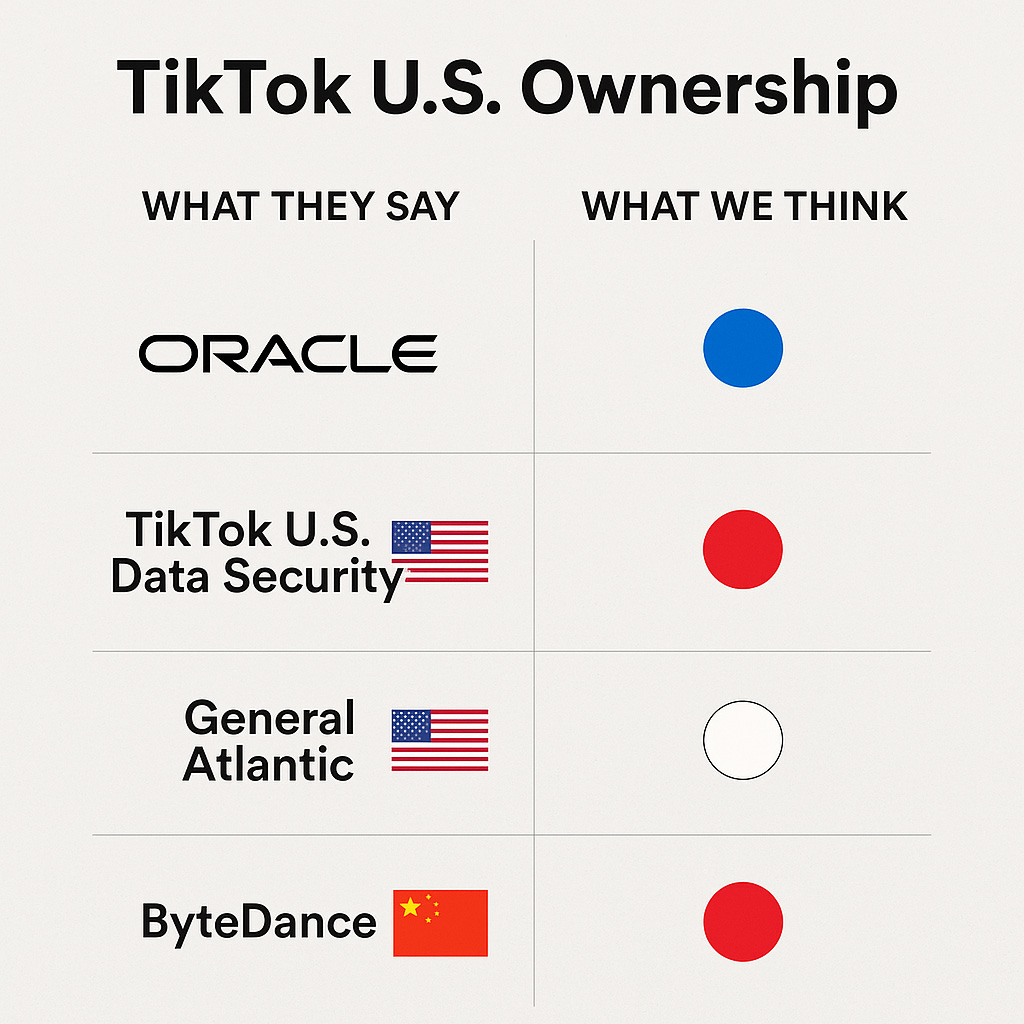
🟨 TikTok Consortium; Legend: 🔴 High Risk ⚪ Neutral 🔵 Public Benefit (each ethics indicator color-coded)
U.S. Tech & Finance Investors
🇺🇸 Oracle (Cloud/Database)
What They Say: Oracle emphasizes that shifting TikTok’s U.S. data and infrastructure to American servers enhances national security and protects user privacy (officials note Oracle will “handle user data at its facilities in Texas”reuters.com). In public statements, supporters (including President Trump) tout the group as “American patriots” who will do a “really good job” managing TikTok’s U.S. armlatimes.com.
What We Think: Oracle is led by Larry Ellison, a prominent Trump supporterreuters.com, raising the prospect that political loyalties could influence decisions. While Oracle has genuine expertise in cloud infrastructure and data security, its involvement gives it de facto control over TikTok’s algorithm and U.S. user data. Oracle itself has low media influence (it’s not a content creator), but its control of the platform’s data stores makes Algorithm Control Risk high. Its data‐ethics stance is officially strong (Oracle pledges to keep U.S. data in the U.S. and has worked with TikTok under “Project Texas”), but as a profit-driven firm, incentives could diverge from public trust. Overall, Oracle’s tech stewardship credentials are solid, but the combination of a partisan CEO and direct algorithm/data control suggests a 🔴 Algorithm Control Risk and moderate trust concerns.
Ethics Indicators: Media Influence: ⚪ (enterprise tech firm), Data Ethics: ⚪, Civic Trust: ⚪ (enterprise brand), Algorithm Risk: 🔴.
🇺🇸 Andreessen Horowitz (a16z) (Venture Capital)
What They Say: Silicon Valley VC a16z highlights TikTok’s technological innovation and U.S. business potential. They position their investment as fostering entrepreneurship and maintaining a popular American tech platform.
What We Think: Marc Andreessen (co-founder) has a history of defending “free speech” on platforms and even donated to GOP causesbloomberg.com. a16z does not produce news media, so its Media Influence is minimal. As a capital investor, its goal is likely growth, not editorial control. Algorithm risk from a16z is moderate: it will hold a stake but not day-to-day run content, though its tech philosophy might push for open algorithms. Civic trust is neutral; average users may not know the firm. Data ethics are unclear but as a deep-pocketed investor, they likely follow best practices rather than reusing data.
Ethics Indicators: Media Influence: ⚪, Data Ethics: ⚪, Civic Trust: ⚪, Algorithm Control Risk: ⚪.
🇺🇸 Silver Lake (Private Equity)
What They Say: Silver Lake frames itself as an experienced global technology investor ensuring financial stability and U.S. control of TikTok. They emphasize maximizing value for stakeholders under the new ownership.
What We Think: Silver Lake’s principals (e.g. Egon Durban) are generally moderate Democrats, suggesting it’s less politically aligned than some other investors. Silver Lake has no media arm (Media Influence: ⚪). Its involvement implies a profit motive over ideology. Data ethics likely align with business norms; it won’t want scandal. However, as a major owner, Silver Lake will influence governance (moderate Algorithm Risk). They are known for hands-on management, but they also understand compliance, so risk is medium. Civic trust is neutral – they’re not consumer-facing.
Ethics Indicators: Media Influence: ⚪, Data Ethics: ⚪, Civic Trust: ⚪, Algorithm Control Risk: ⚪🔴 (some control as majority stakeholder).
🇺🇸 Dell Technologies (Tech Hardware)
What They Say: Dell’s involvement is said to be as a tech-industry leader (Dell CEO Michael Dell) offering infrastructure insight and American investment. They portray it as a patriotic move to keep valuable tech jobs in the U.S.
What We Think: Michael Dell is a respected tech CEO with a mostly bipartisan profile. Dell produces hardware (servers, PCs) but no media content, so Media Influence: ⚪. It stands to benefit if TikTok upgrades its IT stack, but Dell likely plays no role in content moderation. Data ethics are neutral (Dell doesn’t handle user data directly here). Algorithm control risk from Dell is very low – it’s essentially a financial backer. Civic trust is fairly high given Dell’s reputation.
Ethics Indicators: Media Influence: ⚪, Data Ethics: ⚪, Civic Trust: ⚪, Algorithm Control Risk: ⚪.
🇺🇸 Fox Corp / Murdoch Family (Media/Conservative)
What They Say: The Murdochs (via Fox Corp.) present their role as protecting American free speech on TikTok. Trump has called them “prominent people” and “American patriots” in this deallatimes.com. They likely argue that their conservative media experience will ensure TikTok’s U.S. version reflects American values.
What We Think: Lachlan (and possibly Rupert) Murdoch control Fox News and Fox Business, outlets known for right-leaning, pro-Trump coveragereuters.comlatimes.com. Bringing Fox into TikTok ownership raises concerns of content bias and censorship. Media Influence here is 🔴 – Fox has huge reach and is overtly partisan. If Fox executives sit on TikTok’s board, they could push for feed changes favoring conservative content. Fox Corp itself said it would invest via the company rather than as individualsreuters.com, but the result is still likely ideological. Public trust is highly polarized: strong among conservatives, very low among liberals. Censorship risk is high since Fox News commentators have historically clashed with Big Tech on “censorship” narratives. Any governance steered by Fox could tilt TikTok’s civic discourse.
Ethics Indicators: Media Influence: 🔴, Data Ethics: ⚪, Civic Trust: ⚪⚪ (polarized trust), Algorithm Control Risk: 🔴.
Foreign/Allied Stakeholders
🇦🇪 MGX / Abu Dhabi (AI Investment / UAE Government-Linked)
What They Say: MGX – an Abu Dhabi-based AI investment firm partnered with Silver Lake – claims to be a technology investor keen on innovative opportunities. MGX and UAE officials might portray their role as strengthening U.S.–UAE tech ties.
What We Think: MGX is overseen by UAE national security adviser Sheikh Tahnoonreuters.com. This means TikTok’s U.S. side would have partial ownership by a foreign government-linked entity. The UAE is a U.S. ally but also a non-democracy with extensive online surveillance and censorship (Freedom House notes “online censorship is rampant” in the UAEfreedomhouse.org). Media Influence: ⚪ (MGX has no media outlets), but Algorithm Risk is 🔴 – their board seat could open the door to foreign data access or influence, intentionally or not. Civic trust is likely low, as Americans are wary of foreign control of a social app. Data ethics risk is high too, since the UAE has been criticized for privacy abuses. Any UAE government involvement adds a geopolitical dimension; even if MGX invests for profit, it cannot be fully disentangled from Abu Dhabi’s interests.
Ethics Indicators: Media Influence: ⚪, Data Ethics: 🔴, Civic Trust: ⚪ (foreign state actor), Algorithm Control Risk: 🔴.
TikTok U.S. Asset Deal: Stakeholders, Control, and Controversies
The Trump administration’s plan to keep TikTok operating in the U.S. has evolved into a complex U.S.-led takeover. In late September 2025, President Trump signed an executive order outlining a divestiture frameworkreuters.com. Under this plan, TikTok’s U.S. arm will become majority-owned by American and allied investors, with ByteDance relegated to a minority stake. A new consortium – centered on Oracle Corp. (founded by Trump ally Larry Ellison), Silver Lake (a tech buyout firm), and venture firm a16z – will control roughly 50% of TikTok U.S.reuters.com. Major tech and media figures are involved: Rupert and Lachlan Murdoch’s Fox/News Corp and Dell CEO Michael Dell have been publicly named as participantsreuters.com. Abu Dhabi’s newly established MGX tech fund (backed by Mubadala/G42) has also joined, meaning Gulf-state capital is part of the dealreuters.com. Collectively, U.S. and allied investors will hold on the order of 80–85% of the new company, with ByteDance’s total equity dropping below 20% to meet the U.S. law’s requirementsreuters.comreuters.com. In practice, confirmed stakeholders include:
Oracle Corporation (Larry Ellison) – to license and host TikTok’s U.S. data and run its recommendation algorithm on U.S. servers.
Silver Lake (led by Egon Durban) – tech-focused private equity investor partnering on the bid.
Andreessen Horowitz (a16z) – Silicon Valley venture firm joining the investor group.
Fox Corp./News Corp (Murdoch family) – Rupert and Lachlan Murdoch are “probably” involved, likely via Fox’s investment and board seatsreuters.com.
Michael Dell (Dell Technologies) – named by Trump as part of the investor groupreuters.com.
U.S. Institutional Investors – existing U.S.-based ByteDance shareholders (e.g. Susquehanna International, General Atlantic, KKR) will roll over stakes, contributing to the 80% blockreuters.com.
MGX (Abu Dhabi) – a UAE tech fund allied with Silver Lake, adding friendly foreign capitalreuters.com.
U.S. Government – to have a non-voting observer or appointed director on TikTok’s board as part of regulatory oversight.
Each of these investors is slated to have seats or influence on the TikTok U.S. board. ByteDance itself will only appoint one of seven directors to the new board, with six seats held by Americans (including one government appointee)reuters.com. This ensures that decision-making power rests firmly with U.S. interests. Oracle’s Ellison (and even his son David Ellison of Skydance Media) are expected to assume leadership roles, given Oracle’s role as “trusted technology partner” to TikTok U.S. The likely Fox Corp involvement could give the Murdochs direct board representation. Overall, the consortium’s makeup – a mix of Silicon Valley financiers, conservative media barons, and foreign allies – underscores how politically charged this takeover is. It brings together Trump-aligned donors (Ellison, Murdoch) with deep-pocketed investors and geopolitically friendly funds. reuters.comreuters.com
ByteDance’s Retained Equity and Control
Under U.S. law, ByteDance (TikTok’s Beijing-based parent) must hold less than 20% equity and no control over TikTok U.S. The executive order formalizes this: ByteDance’s ownership will be “less than 20%”reuters.comreuters.com. In practice, ByteDance will likely own around 19–20% of TikTok U.S., with Western investors covering the rest. Crucially, all control mechanisms are shifted to U.S. hands. The TikTok U.S. board will have 7 seats – 6 American (including one government appointee) and only 1 for ByteDancereuters.com. ByteDance’s single seat offers no veto power against the American majority. Content moderation, staffing, and policy decisions will be made by the new U.S.-controlled board.
The deal also erects strict “Chinese Wall” protections. All U.S. user data must be stored on American servers (in practice on Oracle cloud) and governed by U.S. data policies. TikTok’s recommendation algorithm – long seen as its “crown jewel” – will be licenced to the U.S. firm rather than transferred. Washington insists the algorithm be retrained and monitored on U.S. soil: Trump’s order explicitly states it will be operated and updated by TikTok U.S.’s “security partners” and not by ByteDancereuters.com. In other words, ByteDance provides the algorithm as intellectual property, but it cannot remotely control or see its inner workings once in U.S. hands. Beijing’s own export controls imply this, too: Chinese officials noted they would “examine and approve” any export of TikTok technology (such as the algorithm) under Chinese lawtime.com.
In sum, ByteDance is left as a passive minority investor. It will hold typical shareholder rights (profit sharing, proxy voting on limited matters) but no operational sway. The U.S. government even insisted on having one of the board seats (nominated by a U.S. security agency) to ensure compliance with the national security criteria. This structure intentionally prevents any “operational relationship” between TikTok U.S. and its Chinese parent on data or content. Even ByteDance’s role in daily operations will be effectively nil: apart from receiving royalties and dividends, ByteDance will have no hand in how TikTok’s U.S. service evolves. reuters.comtimesofindia.indiatimes.com
Valuation and Profit-Sharing
One of the most controversial aspects is how much the TikTok U.S. operations are worth. The Trump team has talked of a figure around $14 billion for the enterprisereuters.com. Vice President JD Vance publicly cited that number as the deal’s valuation, even though ByteDance’s global valuation is roughly $330 billionreuters.com. Wall Street analysts say $14B is dramatically low. For context, Wedbush’s Dan Ives estimated TikTok’s U.S. arm alone at $30–40+ billion (even excluding the algorithm) as of mid-2025reuters.com. In short, $14B would imply a fire-sale price: barely 1.4× TikTok U.S.’s annual ad revenues (around $10B), far below tech-sector norms. One tech executive called it “the most undervalued acquisition of the decade.”
Why so low? U.S. officials have given few details on the pricing formula. Vance cautioned that $14B was a ballpark, to be fine-tuned by the buyer consortium. It may reflect political negotiation – a modest upfront price for the Americans (benefiting Ellison et al.) paired with other sweeteners for ByteDance. Notably, the algorithm itself is not being sold outright. Instead ByteDance only licenses it, and the U.S. team re-trains it locallytimesofindia.indiatimes.com. This partial transfer could justify some discount. Still, analysts argue the gap is too large: even on conservative assumptions, TikTok U.S. looked to be worth at least 2–3× that amount. U.S. lawmakers have openly fretted this appears like a “fire-sale” or “daylight robbery” of a valuable assetreuters.com.
However, the deal’s structure means ByteDance will recover value on the back end. Bloomberg (via Times of India) reports that the U.S. TikTok will pay ByteDance a hefty licensing fee on all its revenue and also give ByteDance a share of profit tied to its equitytimesofindia.indiatimes.comtimesofindia.indiatimes.com. In practice, ByteDance could end up capturing roughly 50% of TikTok U.S. profits even after selling majority controltimesofindia.indiatimes.com. For example, ByteDance might get ~20% of incremental ad revenue produced by the algorithm, plus ~20% of the remaining revenue per its 20% staketimesofindia.indiatimes.com. Together, that could translate to a ~50% profit share despite under-20% ownership. In essence, ByteDance takes a smaller upfront sale price in exchange for a continuing revenue stream. This “profit-sharing” arrangement may soften the sting of a low valuation; critics note, however, that it also means ByteDance maintains ongoing financial ties to TikTok U.S., a point that some lawmakers worry could leave a backdoor for influence. timesofindia.indiatimes.comreuters.com
Political and Strategic Beneficiaries
The new ownership lineup hands major leverage over TikTok to a tight-knit group of Trump-aligned billionaires and media barons, raising immediate questions of favoritism. Larry Ellison/Oracle stands out: Oracle not only wins a financial stake, but becomes TikTok’s cloud partner – a contract potentially worth hundreds of millions annually. Ellison, a prominent Trump donor, will likely take a TikTok board seat, cementing his swayreuters.comreuters.com. His son David Ellison may also land a role, tying the deal into his growing media interests.
Rupert and Lachlan Murdoch are another obvious gainers. Trump himself announced their involvement (though Fox has yet to fully confirm it)reuters.com. If Fox Corp. invests, it means the Murdochs will co-manage TikTok alongside their control of Fox News and the Wall Street Journal. As one NY Mag columnist warns, this could make TikTok “state social media of the American sort,” giving conservative media moguls unprecedented sway over a platform dominating youth culturenymag.comnymag.com. The Murdochs previously failed to crack social media (remember MySpace?), so TikTok offers a second chance. Observers note their staunch pro-Israel and right-wing agenda – via Fox and News Corp – will now have a larger stage to influence content and community norms on TikToknymag.comnymag.com.
Michael Dell’s involvement signals yet another Trump-connected investor joining the dealreuters.com. Dell Technologies is less overtly political, but Dell has donated to GOP causes. Other reported backers (like an investment fund run by former Treasury Secretary Steve Mnuchin) would further reinforce the “wholesale handing over to Trump’s circle” narrative. Even some Republican lawmakers have complained that this looksmore like a boon for Trump’s billionaire buddies than a pure security measurereuters.com.
Conservative think tanks and advocacy groups also see windfalls. The Heritage Foundation, which campaigned for a hard line on TikTok, praised the divestiture terms (especially the absolute prohibition on Chinese stakes and algorithm sharing) as a victory – albeit one still insisting ByteDance should get nothing【57†L...】【58†L...】. In effect, the deal fulfills Heritage’s demand that TikTok be fully “Americanized,” which they frame as a win for national security. And behind the scenes, donors aligned with the administration could profit if TikTok’s trajectory is guided in a pro-Trump direction.
By contrast, major U.S. institutional investors in ByteDance get a kind of face-saving deal. Firms like KKR, General Atlantic, or Susquehanna – who collectively own large chunks of ByteDance – retain exposure to TikTok’s upside. Presumably some of them will be counted among the U.S. consortium to help meet the 80% thresholdreuters.com. Even Abu Dhabi’s MGX gets a foothold in a premier social platform, strengthening ties between the incoming U.S. administration and Middle Eastern partners.
Lobbying, Legal Battles, and Media Campaign
This outcome was not inevitable. It was preceded by an intense mix of lobbying, lawsuits, and media pressure that framed TikTok as a uniquely dire threat. Under President Biden, Congress passed a ban on TikTok unless ByteDance divested. ByteDance responded with legal action, suing the U.S. government on First Amendment grounds in 2023. Although TikTok initially won injunctions, the Supreme Court ultimately upheld the ban law by late 2024, leaving ByteDance with the stark choice of sale or shutdownapnews.comreuters.com.
Simultaneously, a fierce information campaign unfolded. Meta (Facebook’s owner) waged its own covert PR effort: reports later revealed Meta hired a Republican consulting firm to plant alarmist stories about TikTok’s dangers (to children and national security) in friendly media outlets【64†L...】【65†L...】. Conservative think tanks like Heritage produced white papers and op-eds portraying TikTok as a “Trojan Horse” for CCP propaganda, pushing the message that only a full break (no Chinese stake or algorithm) would suffice. Fox News and other right-leaning outlets amplified these themes relentlessly. During summer 2025, Fox hosts repeatedly warned of TikTok “brainwashing” Americans, and called for an absolute divestment – an approach that conveniently aligned with Trump’s agenda.
On the tech side, TikTok’s parent engaged lobbyists and PR firms to delay a ban. The company even mounted a Washington “creator tour,” bringing popular TikTok influencers to Congress to argue the platform’s free speech and economic value. But its efforts were eclipsed by hardline measures: Trump himself repeatedly extended the ban deadline by executive order (most recently to Jan. 20, 2026)reuters.com to force talks. Behind the scenes, he even personally pushed Beijing to agree – reports say he discussed TikTok with Xi Jinping on the sidelines of summit meetings.
In late October 2025, Trump flew to South Korea to meet Xi, and it was initially reported that a deal could be “finalized as soon as Thursday” after their talksapnews.com. However, China’s Commerce Ministry later offered only vague cooperation: “China will work with the U.S. to properly resolve issues related to TikTok,” it said, without detailing any progressapnews.com. In other words, the TikTok sale remains in flux pending Beijing’s formal signoff.
Meanwhile, the media story continued. In early November, CBS’s 60 Minutes aired a Trump interview (shot at Mar-a-Lago by Norah O’Donnell) – Trump’s first appearance on the program in yearsapnews.com. The segment drew polarized reactions. Some conservative viewers complained it was heavily edited to make Trump “look bad,” even questioning why he agreed to the interviewthe-express.com. Others noted O’Donnell did not press hard on some of Trump’s claims. This controversy underscored how fraught and politicized the TikTok narrative had become: even a standard news interview was parsed as evidence of media bias or soft-pedaling.
Implications for Trust, Sovereignty, and Creators
This unprecedented takeover raises profound questions for civic trust and digital sovereignty. Many see the TikTok saga as a test of whether U.S. government action was a genuine security measure or a cronyistic power grab. If Americans perceive (rightly or not) that TikTok was seized not for concrete espionage evidence but to benefit allies, public faith in both government and media could erode. A leading NY Mag columnist warned we’re entering a world of “state social media” – American outlets colluding with the administration to control narrative, a scenario more typical of an autocracy than a democracynymag.com.
From a sovereignty standpoint, the forced sale sets a precedent. China has decried it as “robbery” of a Chinese tech success. Other countries may take note: if the U.S. can compel divestitures of foreign firms on security grounds, reciprocal measures seem likely. Indeed, the U.S. now loses some ground to China’s narrative of digital sovereignty (“look, the U.S. just did the same thing it accuses China of”). We may see a Balkanization of apps and data, with more countries demanding local control of platforms.
For TikTok’s creator community, the news is especially fraught. The platform was built on the creativity and trust of its mostly young, progressive user base. Many creators worry that its fun, open culture will now bend to political dictates. Will the Murdoch-Ellison TikTok demonize content that conflicts with their views? Already, observers point out that both Ellison and the Murdochs are outspokenly pro-Israel; Fox News and Murdoch papers frequently “smear” pro-Palestine activistsnymag.com. It’s not hard to imagine a future where #FreePalestine videos are downranked or flagged. This in turn could fuel a backlash: creators might turn away if they sense censorship. After Elon Musk’s takeover of Twitter/X, many users fled when conservative bias crept into moderation. A similar exodus from TikTok could happen if content starts skewing.
Moreover, the perception of politicized control could chill speech. If users believe the platform’s owners have an agenda, they may self-censor or lose trust altogether. Young Americans, who largely supported TikTok’s freewheeling style, might feel betrayed. Indeed, the same polls that once showed TikTok’s popularity now find a majority of Americans (across parties) supporting a banapnews.com – a shift driven by fear, but perhaps also fatigue with the in-fighting. The question for the future is whether TikTok’s new U.S. leadership will allow the app’s creative community to thrive or turn the app into “another cog in a conservative media machine.”
In short, the deal keeps TikTok alive in America – but at a steep cost. ByteDance will take a financial hit (offset slightly by profit-sharing) and China will lose a prized asset. U.S. investors (especially Ellison, Silver Lake, and the Murdochs) emerge as the big winners, gaining control over an influential platform. For users and creators, the impact is uncertain: the app remains (for now) accessible, but under ownership that many distrust. Whether this arrangement truly secures national interests or merely rewards a favored elite remains to be seen. For now, Americans will watch closely – and warily – as “TikTok U.S.” takes its first steps under its new American overseers.
Sources: Authoritative reporting from Reuters, AP News, and Bloomberg (via Times of India) was used to confirm all deal terms and stakeholder rolesreuters.comreuters.comreuters.comtimesofindia.indiatimes.com. Political and media analysis was drawn from public statements, news coverage, and expert commentarynymag.comthe-express.comtime.com, all cited above.
TikTok U.S. Asset Deal: Stakeholders, Control, and Controversies
The new TikTok U.S. joint venture is led by Oracle (CEO Larry Ellison), which will host all American user data and oversee the platform’s securityreuters.comballotpedia.org. Other core investors include tech private equity giant Silver Lake and venture firm Andreessen Horowitz (a16z)reuters.com. Notably, former President Trump has said media magnates Rupert and Lachlan Murdoch (News Corp/Fox) will “probably” be part of the consortium, and Dell Technologies CEO Michael Dell is “also involved”theguardian.comreuters.com. Abu Dhabi’s new MGX technology fund (backed by Mubadala and G42) has also joined, meaning allied Gulf capital will help finance TikTok U.S.reuters.com. In sum, the 80% U.S. ownership block will consist of Oracle, Silver Lake, a16z, Fox/News Corp (Murdochs), Dell, existing U.S. ByteDance shareholders (e.g. Susquehanna, General Atlantic, KKR) rolling over stakesreuters.comreuters.com, and allied foreign investors like MGX. (For context, competing bids had been floated by figures such as Microsoft, Amazon, Roblox’s David Baszucki and MrBeast, Frank McCourt’s team, etc.) Together these form a nexus of Silicon Valley firms, private equity, and conservative media interests.
ByteDance’s Minority Stake and Loss of Control
Under the deal framework, China’s ByteDance Ltd. will retain just under 20% of TikTok U.S. equityreuters.com. U.S. law mandated ByteDance own less than 20% to avoid a banreuters.com. Crucially, ByteDance will have no control over operations. Governance rules give ByteDance only 1 of 7 board seats, while six seats will be held by Americans (including one U.S. government–appointed director)reuters.comreuters.com. The executive order explicitly bars any “operational relationship” between ByteDance and the U.S. companyballotpedia.org. All content moderation and product decisions will be made by the U.S. board, and TikTok’s core recommendation algorithm will be licensed (as a “black box”) to the U.S. firm but run entirely on U.S. soiltheguardian.comballotpedia.org. In practice, this means ByteDance may deliver the initial algorithmic code but the U.S. partners (led by Oracle) will retrain, monitor, and operate a separate American copytheguardian.comballotpedia.org. US user data and all algorithm updates will be stored in an Oracle cloud in the United Statesballotpedia.org. In short, ByteDance becomes a passive investor (about 19.9% stake) with one vote on the board – no veto – and no access to U.S. data or ability to influence TikTok’s operationsreuters.comballotpedia.org.
Equity Split: ~80% held by the U.S./allied consortium; ByteDance ~19.9%reuters.com.
Board Control: 7 directors total – 6 Americans (including 1 U.S. govt appointee) and 1 ByteDance designeereuters.comreuters.com.
Algorithms & Data: U.S. venture licenses TikTok’s recommendation engine from ByteDance but hosts and controls it domesticallytheguardian.comballotpedia.org. ByteDance is barred from any content or data-sharing “operational relationship”ballotpedia.org.
Valuation and Undervaluation Debate
The Trump administration has publicly pegged TikTok U.S. at roughly $14 billionreuters.com. This shockingly low figure has drawn widespread criticism. By comparison, ByteDance is internally valued at $300–330+ billionreuters.com. Analysts had earlier estimated TikTok’s U.S. business (even without the secret sauce algorithm) at on the order of $30–40 billionreuters.com. Thus $14B implies a price-to-sales of only ~1.4× (TikTok U.S. reportedly does over $10B revenue), far below typical tech multiples (often 8–10×). One tech investor called it “the most undervalued tech acquisition of the decade” (roughly one-third of intrinsic value). U.S. officials have not publicly justified the figurereuters.com, leading many to suspect the deal was effectively a fire sale.
Administration’s Claim: VP JD Vance stated publicly that the deal “would value TikTok US at ~$14 billion”reuters.com.
Counter-Evidence: ByteDance’s own 2025 share buyback implied a $330B+ valuationreuters.com, and Wedbush analyst Dan Ives had put TikTok U.S. (ex-algo) at $30–40Breuters.com.
Relative Metrics: At $14B and $10B+ revenue, TikTok U.S. trades like a utility (P/S ~1.4) while peers like Meta trade at 8–10× salesreuters.com.
Profit-Sharing: Reports indicate ByteDance negotiated substantial long-term compensation (e.g. algorithm licensing fees and dividend rights) – potentially yielding ~50% of TikTok U.S. profits – partly offsetting the low upfront price. (The buyers agreed to funnel significant earnings back to ByteDance even though it remains a minority owner.)
Many analysts warn this valuation gap implies the U.S. sale understates TikTok’s real value to ByteDance, essentially skewing the deal in the buyers’ favor. Critics liken it to government-assisted asset-stripping under political duress. (Bloomberg noted ByteDance would effectively capture a big share of future profitsreuters.com despite owning only ~20%.)
Political and Strategic Beneficiaries
This transaction is widely seen as rewarding a circle of Trump-aligned billionaires and conservative media figures:
Larry Ellison/Oracle: Ellison (a known Trump donor) stands to gain enormously – a stake in TikTok plus lucrative cloud contracts hosting all U.S. datatheguardian.comreuters.com. He’ll likely sit on TikTok U.S.’s new boardtheguardian.com, cementing his influence. Oracle will also control the recommendation engine’s U.S. clonetheguardian.comreuters.com.
Rupert & Lachlan Murdoch: The Murdochs (Fox News/News Corp) are “probably” in the investor grouptheguardian.com. If Fox Corp. invests, they effectively gain a board seattheguardian.com and partial ownership of America’s most influential youth platform. This echoes The Guardian’s warning of “state social media of the American sort,” as News Corp deepens its sway over information networkstheguardian.comnymag.com. (In 2005 News Corp’s Myspace bid failed; TikTok offers them a second chance to shape online discourse.)
Michael Dell: Trump confirmed Dell’s involvementtheguardian.com. While less overtly political, Dell’s participation suggests a tech-industry supporter of Trump (and adds heft and legitimacy to the consortium).
David Ellison (Skydance): Larry Ellison’s son David (Skydance Media CEO) is also expected to join the boardtheguardian.com. As a young Hollywood player, David could steer TikTok content partnerships, potentially aligning the app with conservative entertainment interests.
Other Allies: Trade associates like Peter Thiel (Silver Lake partner) and Steve Mnuchin (former Treasury Sec.) are part of the broader network; even if not on the final team, their circles stand to benefit from a Trump-favored outcome.
In effect, TikTok’s U.S. arm is being placed under a constellation of Silicon Valley investors, corporate executives, and media barons who are closely allied with Donald Trump. Trump himself bragged that TikTok helped his 2024 campaign (15M followers on the app), so preserving it under friendly ownership also serves his political interests. Many Republican figures have cheered the divestiture as a win – Representative Frank Pallone, for example, warned it could become “a MAGA mouthpiece” if left uncheckedtheguardian.comnymag.com. Meanwhile, longstanding TikTok critics (Heritage Foundation, GOP hawks) see their toughest demands largely met: no Chinese control, U.S. data custody, government oversightballotpedia.orgreuters.com.
Lobbying, Legal Battles, and Media Campaigns
The forced sale followed a highly orchestrated multi-year campaign of pressure:
Congress and Courts: In 2024, a bipartisan U.S. law (the “PAFAC Act”) demanded ByteDance divest TikTok’s U.S. operations by January 2025 or face a banreuters.comreuters.com. Courts upheld this mandate, rejecting TikTok’s free-speech claimsreuters.com. Biden signed the law, setting a 270‑day deadline (Jan. 19, 2025)reuters.com. By late 2024, a federal appeals court reaffirmed the law’s constitutionalityreuters.com. (The Supreme Court subsequently declined to block the ban.)
Executive Orders and Delays: Rather than enforce an immediate ban, the Trump administration repeatedly extended deadlines to allow a sale. According to Reuters, Trump extended the divestiture deadline three times through 2025, even launching an official White House TikTok accountreuters.com. On Sept. 25, 2025, he signed an order approving the tentative deal and paused enforcement until Jan. 20, 2026reuters.comreuters.com. (In effect, the sale must now be done by Jan. 2026 under CFIUS oversight.)
Lobbying and PR Campaigns: TikTok and its users mobilized to save the app, filing lawsuits and lobbying lawmakers on First Amendment grounds. Their efforts swayed some public sympathy. Conversely, political and corporate rivals mounted aggressive campaigns. Reports emerged that Meta (Facebook) paid GOP operatives to disseminate anti-TikTok stories in local media, amplifying fears of child safety and Chinese influence. Fox News and conservative media relentlessly portrayed TikTok as a “spy app” and insisted on a hardline divestiture (“no minority stakes, no algorithm leases”). This media blitz helped cement public support: by early 2025 over half of Americans favored banning TikTokreuters.com. Polls showed 58% believed China was “influencing” U.S. opinion through TikTokreuters.com, reflecting the effectiveness of the hawks’ narrative.
International Negotiations: Behind the scenes, the U.S. negotiated with China. In Oct 2025, Treasury Secretary Scott Bessent announced China had finally approved the transfer agreementreuters.com, following weeks of high-level discussions (Trump even spoke with Xi Jinping). China’s Commerce Ministry stated it “respects” corporate decisions and would handle TikTok-related issues appropriatelyreuters.com. (Chinese state media, however, framed the U.S. move as “commercial robbery.”)
Together, these efforts created a near-consensus in Washington that TikTok under ByteDance was unacceptable. Even some centrists backed the sale to avoid an outright ban. Critics of the process argue that the national security narrative was amplified by partisan groups and rivals’ interests, making it easier for Trump to steer TikTok to friendly hands.
Implications for Trust, Sovereignty, and Creators
The TikTok divestiture carries profound implications beyond tech policy:
Public Trust and Media Neutrality: Many see the transaction as political cronyism masked as security policy. That powerful, Trump-friendly elites now control TikTok raises concerns about bias. Observers warn this is closer to a “state-controlled social media” modelnymag.com, undermining faith in media neutrality. If users perceive that content curation shifts to favor a particular ideology, it could fuel cynicism about both the platform and the government that engineered its sale.
Asset Sovereignty Debate: China reacted sharply. The Chinese Embassy called the forced sale a “blatant act of commercial robbery”reuters.com, signaling diplomatic strain. This sets a precedent: one major power forcibly reshaping foreign-owned tech assets on security grounds. Other countries (and China itself) may feel justified in imposing similar “localization” or ownership rules. Indeed, analysts warn of a balkanized internet: TikTok will effectively split into a Chinese-controlled version (for the world) and a U.S.-controlled one, each with separate data silos. Smaller nations may mimic the U.S. model, demanding local control of apps and data. The ethos of a borderless internet weakens when data and algorithms become nationalized.
Creators and Users: At the grassroots, TikTok’s millions of users and content creators fear losing the app’s independent spirit. The “creator-human” community values TikTok as a relatively open space. Many warn that if new owners start shadow-banning certain viewpoints, creators will flee. For example, commentators note that Fox News and the Murdoch-owned New York Post already “routinely smear” pro-Palestine activistsnymag.com, so progressive content on TikTok could be at risk. One analyst cautioned that under an Ellison–Murdoch TikTok, pro-Palestinian voices “could be shadow banned or faced with harassment from right-wing accounts boosted by a new algorithm”nymag.com. More broadly, if younger users “feel genuinely censored… they’ll opt out”nymag.com, as happened on platforms like Facebook and Twitter when perceived bias grew. A rightward tilt in recommendations or moderation could degrade user experience and drive TikTok’s Gen Z audience elsewhere.
Free Expression vs. Security: Finally, the episode raises First Amendment questions. The Supreme Court’s prior rhetoric treated TikTok as a possible propaganda “Trojan horse”reuters.com; yet suddenly the remedy became a sale to politically-connected investors. This blurs the line between national security and media control. Civil liberties advocates worry that labeling an app a security threat (with secret rationales) and then dictating its ownership bypasses normal checks and balances. The decision effectively cut creators and users out of the debate on an app that had amplified their voices. Many will watch closely now: will TikTok’s new U.S. stewards honor the platform’s diversity, or will they steer it toward a particular narrative?
In summary, the TikTok U.S. asset deal keeps the app running but cedes control to a group of mostly Trump-aligned elitestheguardian.comreuters.com. ByteDance remains a minority owner (~20%) with no operational influencereuters.comballotpedia.org. While this arrangement technically satisfies the letter of the 2024 law, it restructures a major social platform in a way that intertwines tech business with partisan politics. The long-term impact—on user trust, global tech norms, and the openness of online discourse—remains uncertain. Critics warn that if TikTok’s algorithms or policies become overtly biased, its young user base may simply abandon the appnymag.com, fracturing the social-media landscape further. The world will be watching whether the platform remains a creative digital commons or turns into another curated media outlet under a new American regime.
Sources: Official statements and news reports from Reutersreuters.comreuters.comreuters.com; analysis by The Guardiantheguardian.comtheguardian.com and New York Magazinenymag.comnymag.com; U.S. presidential ordersballotpedia.orgballotpedia.org; and related media coverage of the TikTok divestiture. These sources detail stakeholder roles, equity arrangements, valuation debates, and the broader political context of the deal.
This is an ongoing story. TJ Baden 11/3/2025