


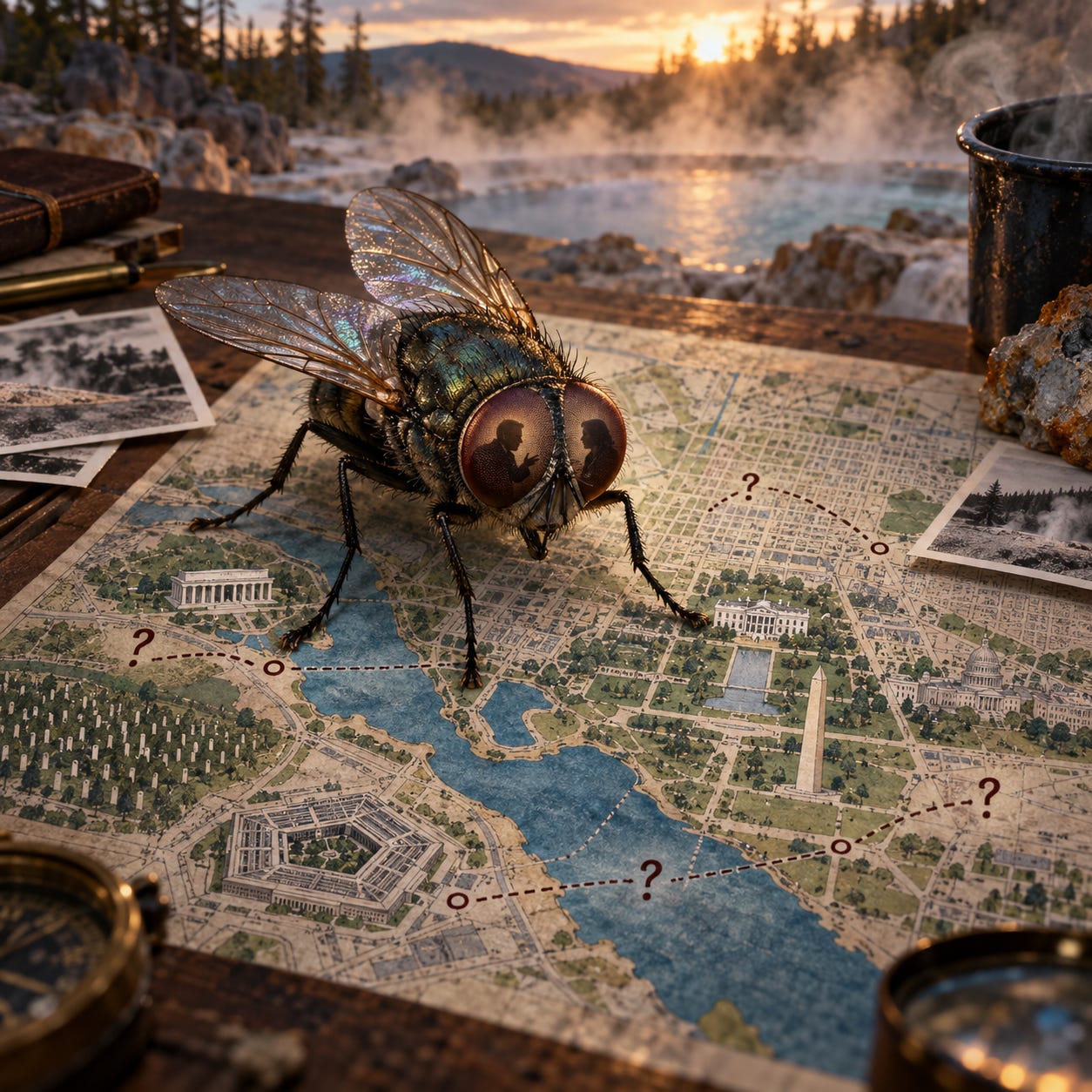
Everybody should have a Jeff Goldblum moment.
Mine happened yesterday at an Oregon hot spring. A woman looked at me and, for one heart-stopping second, thought Jeff Goldblum had wandered off the set of The Fly and into the steam.
Then she had the guts to approach me.
I am not Jeff Goldblum. Apparently, I am close enough to cause a minor public incident.
What began as mistaken identity became recognition of another kind. She is raising a 13-year-old daughter on her own. She pays attention, asks questions and carries a map of concerns that few people will sit still long enough to examine with her.
By the time we left, I had a new friend and maybe a new subscriber. She had someone willing to listen.
The funny part? We had already made an image of a flying insect wearing my glasses. Only afterward did Jeff Goldblum walk into the story.
Yesterday, the fly landed on the map.
The Crown Room

A year ago, I made The Crown Room as satire: an image about a ballroom, power and the architecture growing around the presidency.
It was an artist’s question.
The public description of the White House East Wing project has since expanded. What was announced in July 2025 as a privately funded $200 million ballroom is now discussed alongside underground security construction, medical facilities, protective features and rooftop drone defenses. Contractor records obtained by The Washington Post put the project’s March 2026 estimate at $600 million, with $307 million assigned to taxpayer-funded sources. That is an estimate and funding projection, not a final accounting. (washingtonpost.com)
The Post also obtained an East Wing construction agreement worth up to $500 million that was awarded without competitive bidding. The contract cited concern that disclosing the government’s requirements could compromise national security. (washingtonpost.com)
A separate investigation identified at least $927 million in planned work on and around the White House grounds, encompassing the East Wing and other projects. Those figures describe a broader construction portfolio; they should not be added to the East Wing estimate as though they were separate bills for the same work. (washingtonpost.com)

Then came the second point on the map.
On September 20, 2026, President Trump described his proposed 250-foot triumphal arch near the Lincoln Memorial–Arlington axis as a “military complex” with drones, ammunition and positions for snipers. He said the military had requested that function. The proposal remains contested, and the military purpose he described should be distinguished from an independently established Defense Department requirement. (reuters.com, reuters.com)
The Crown Room remains satire. The costs, contracts, construction reporting and president’s statements are the public record we can examine.
The map has layers
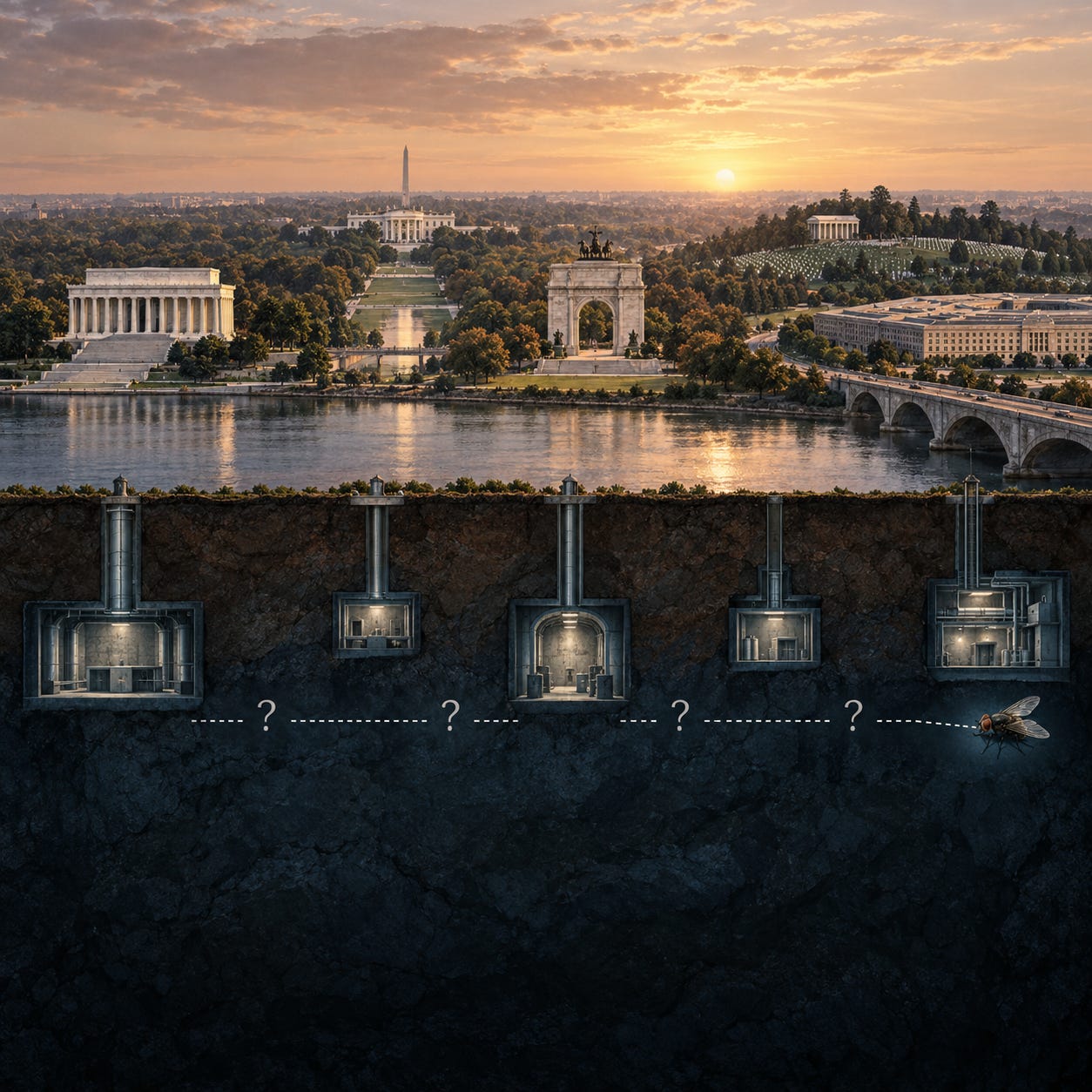
A capital’s defenses are a system of people, facilities, communications and public utilities. NORAD has publicly described an integrated defense network for the National Capital Region that coordinates detection and response across agencies. It has also explained that no single system can address every kind of airborne threat. (norad.mil)
Here are ten defensive functions a reader can understand without mistaking them for a list of ten installations:
Function
Why it matters
1. Early warning
Sensors help distinguish ordinary activity from a possible threat.
2. Shared decisions
Agencies need a common picture before they can coordinate a response.
3. Drone response
Small unmanned aircraft present a different challenge from conventional planes.
4. Air defense
Layered systems address different kinds of airborne threats.
5. Leadership protection
Protected facilities help essential personnel survive an emergency.
6. Continuity of government
Alternate arrangements preserve essential government functions.
7. Secure communications
Leaders and responders must remain able to exchange trustworthy information.
8. Reliable utilities
Power, water and ventilation support every other function.
9. Medical response
Treatment and emergency care matter during a crisis.
10. Transport and recovery
People, supplies and services must be able to move and return.
That is a functional map. It does not tell us that each function occupies a new building, or that the buildings are physically joined.
Where the arch fits

Trump’s description gives the proposed arch a stated military role. It does not, by itself, show how that role would be designed, approved or connected to existing defenses. Reuters reported on September 22 that the administration had invoked national security arguments in disputes concerning both the arch and the ballroom; the White House described the ballroom’s security enhancements as work developed with the White House Military Office and Secret Service. (reuters.com)
That makes the right public question more precise:
What specific function is proposed, who requested it, who would authorize it, and how would the public account for its cost?
The White House already has a history of underground emergency facilities. That history helps explain why new underground work draws attention. It does not establish a continuous tunnel from the East Wing to the arch, Arlington or the Pentagon. (washingtonpost.com)
On our map, the dotted line stays dotted.
And then…
The fly moves from the ballroom to the arch, from the arch to the ten layers of defense, and from those layers back to the people who live with the decisions.
Its job is to look closely.
We can trace a changing public description. We can compare statements with contracts and costs. We can ask whether a proposed monument has a documented military requirement. And we can leave a physical connection unmarked until evidence establishes one.
That is the map I want to share.
The fly can land on it.
It cannot draw the missing tunnel.
Walk it back. Hack it forward. Stay Human.
— Alligator Pope 🐊👁️
Creator Human | Engine 2550

Source trail
East Wing cost and funding records — The Washington Post, June 16, 2026
East Wing construction contract — The Washington Post, June 30, 2026
Broader White House construction plans — The Washington Post, August 12, 2026
Security claims concerning the arch and ballroom — Reuters, September 22, 2026
History of White House underground facilities — The Washington Post, June 1, 2020
Public description of layered capital air defense — NORAD/USNORTHCOM
Image sequence: the earlier fly in glasses → The Crown Room → the public defense map → The Missing Span. Caption the illustrated maps as conceptual artwork, not engineering plans.