



THE DECK | 40 Billion Argentina Getaway
Billionaire-funded immunity and what it means for the rule of law.
Policy Brief: Trump Legal Defense Funding Network
TJ BADEN | CreatorHuman™
A little Buffett goes a long way when we listen — OpenAI Proprietary: Truth Engine 2550™ · My I.P. Printing Press™
I. Legal Dimensions
1. Unprecedented scale of legal defense
Since leaving office, Trump’s legal and related costs have exceeded $100 million, much of it covered not by his own funds but by political committees and donor networks. Spokesman-Review+1
Ongoing matters span four criminal cases, multiple civil actions, appeals, and associated investigations, producing an effectively continuous, national-scale defense operation.
2. Funding mechanisms and gray zones
Save America PAC has spent more than $60 million on legal fees for Trump and allies since 2020, draining what was once a nine-figure war chest. Wikipedia+1
Funds originally raised under banners like “election integrity” are being used for personal and criminal defense costs.
Super PACs and aligned committees accept unlimited contributions, often via LLCs or intermediaries that obscure the true source.
Business entities tied to Trump have paid legal bills that mix corporate and personal defense, exploiting blurry lines between “business expense” and “personal liability.”
3. Impact on the judicial system
The result is a two-tier justice system:
Ordinary defendants face plea pressure, limited motions, and overworked public defenders.
Trump can pay elite firms, file endless motions and appeals, and strategically delay proceedings.
Courts, prosecutors, and witnesses shoulder the burden of an asymmetric war of attrition, not a normal adversarial process.

II. Financial Dynamics
1. Who’s paying?
Investigative work and FEC data point to a donor pool dominated by: Brennan Center for Justice+1
Ultra-wealthy individuals (billionaires and major donors) writing checks in the $5–10+ million range.
Industry clusters whose profits hinge on deregulation and access:
Hedge funds / private equity
Big tech and platform companies
Fossil fuels and extractive industries
Real estate and luxury development
Media conglomerates profiting from polarization
Private prisons, defense contractors, and some crypto actors
2. Investment logic
From an investor’s lens:
These donors are not acting as charity; they’re making a high-beta political investment:
Deregulation worth billions in avoided costs.
Tax cuts and loopholes preserving vast capital gains.
Weakened antitrust, environmental, and consumer enforcement.
Friendly appointments throughout DOJ, agencies, and the judiciary.
Return on investment (ROI) logic:
Paying $5–10 million to help keep a politically useful figure viable is rational if the expected policy upside is measured in hundreds of millions or more.
3. Financial infrastructure that hides the ball
A web of PACs, super PACs, leadership PACs, joint fundraising committees, and LLCs makes tracing the original dollar extremely hard.
Money can flow out from Save America, into a super PAC, and back again via refunds as legal bills spike — a recycling loop optimized for legal coverage, not voter-facing campaigning. Election Law Blog+1
This complexity functions like financial fog: technically disclosed, practically unreadable to the public.
III. Ethical and Governance Concerns
1. Quid pro quo without a receipt
Even without an explicit written deal, the pattern is clear:
Donors fund survival during maximum legal exposure.
In return, they anticipate regulatory indulgence, access, and protection if he regains or retains power.
This creates a shadow obligations ledger:
“You stood by me when I faced prison; I will stand by you when your industry faces scrutiny.”
2. Accountability gaps
Most of this activity complies with the letter of campaign finance law:
PAC rules allow broad spending categories.
Donor disclosure thresholds are porous and delayed.
Super PACs can legally accept unlimited contributions.
But it violates the spirit of both:
Legal ethics (independence of counsel, conflict-free defense).
Democratic accountability (voters should be able to see who effectively “owns the risk” on a defendant-candidate).
3. Erosion of equal justice
When billionaires can collectively build a private justice shield, it sends a simple message:
Law is negotiable if you can marshal enough capital.
This corrodes:
Public trust in courts (people assume outcomes are pre-priced).
Deterrence (future actors learn that sufficient money can blunt accountability).
Rule-of-law norms, which depend on the perception that no one is above the law.

IV. Historical and Systemic Implications
1. A new model of “billionaire immunity”
Historically, wealthy individuals have funded their own defenses.
What’s emerging here is different:
A syndicate model, where multiple billionaires and industries co-fund a single political figure’s legal survival.
The legal defense becomes a joint venture in regime protection, not just personal loyalty.
2. Continuity with 20th-century patterns — but scaled
American history is full of examples where concentrated wealth:
Bankrolled union-busting, coups abroad, and deregulatory waves at home.
Used legal firepower and PR to fend off antitrust and fraud cases.
The Trump defense network inherits that lineage but adds:
Globalized capital flows.
Real-time media and algorithmic influence.
An open, almost shameless link between legal defense and future policy favors.
3. Stress test for institutions
This moment functions as a live-fire test:
For courts & prosecutors:
Can they enforce law fairly against a defendant backed by effectively unlimited resources?For legislatures:
Will they tolerate a world where PACs and super PACs can quietly build “immunity networks,” or will they move to close the loopholes?For democracy:
Can voters still believe in equal justice when one person’s defense is structured like a billion-dollar private equity deal?
V. Conclusion & Reform Pathways
What this deck is really saying:
This is not “just another Trump story.”
It’s a proof-of-concept for how oligarchic wealth can:
Buy time,
Bend process, and
Potentially nullify accountability at scale.
Policy directions (nonpartisan frame):
Transparency upgrades
Real-time, machine-readable disclosure of any political entity paying legal bills for candidates or officeholders.
Clear tagging of expenditures as campaign, personal, or legal defense.
Firewall rules
Limit the percentage of leadership PAC and campaign funds that may be used for personal criminal defense.
Distinct registration and reporting for “legal defense PACs”, with stricter donor transparency.
Ethics and conflict-of-interest safeguards
Stronger rules for lawyers and firms accepting third-party defense funding tied to political or regulatory interests.
Recusal standards where defense donors have active matters before agencies or courts influenced by the defendant.
Equal-justice reinforcement
Investment in public defense and prosecutorial resources so that legal firepower is not entirely outgunned by billionaire-funded defense teams.
Periodic independent reviews of high-disparity cases (where one side’s spending massively exceeds the other’s) for systemic lessons.

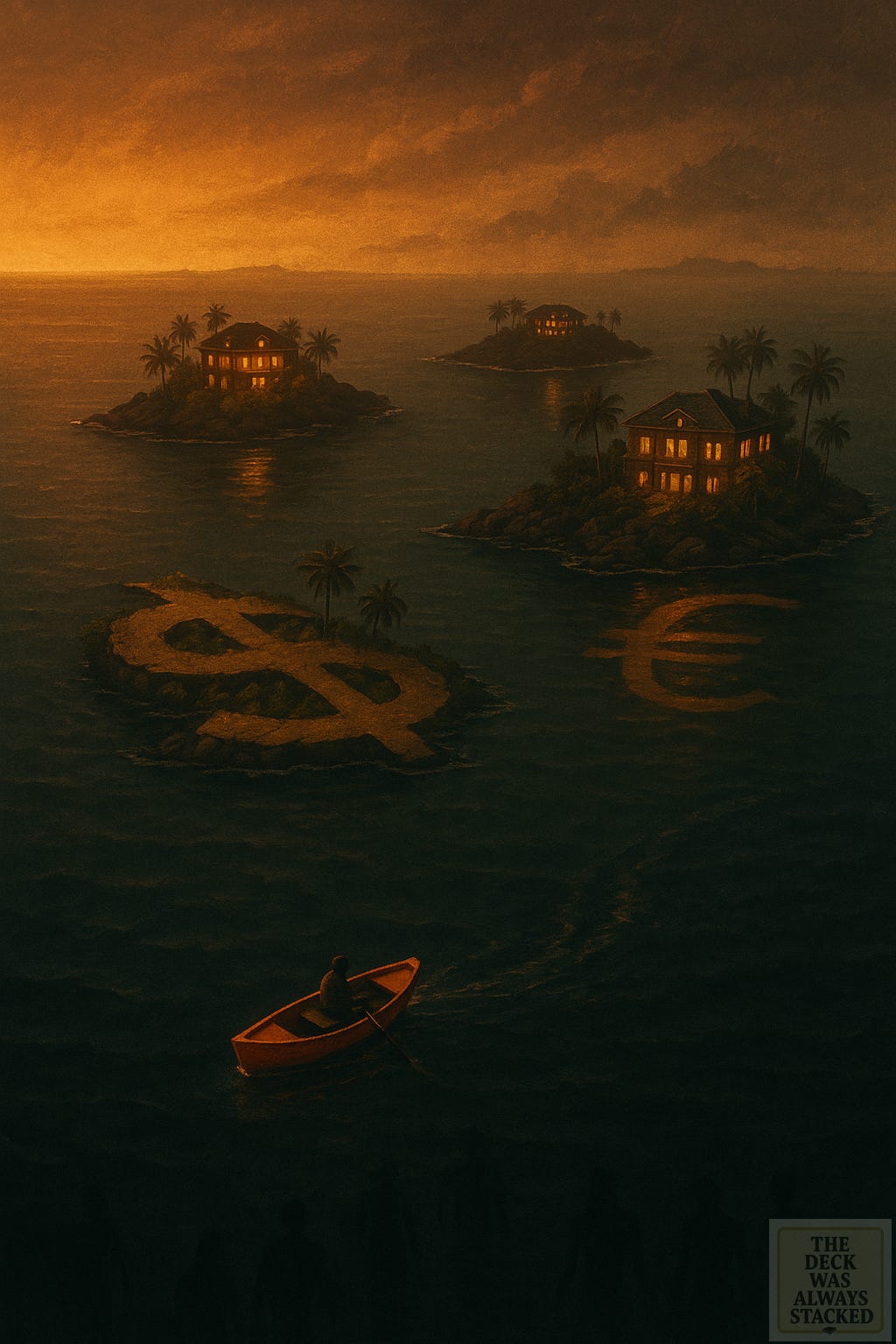
The offshore escape plan is older than any presidency — this is just the newest route.
TJ Baden | CreatorHuman ™ Truth Engine 2550™
Hey, great read as always. The legal structure enables such resource asymmetry.